
Diese dient lediglich Demonstrationszwecken.
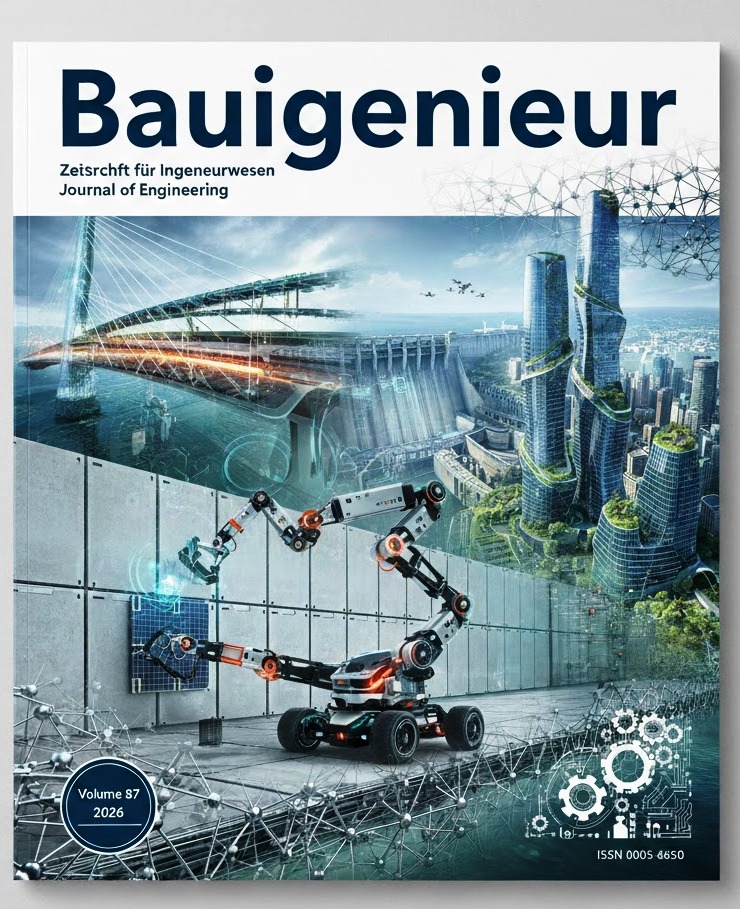

BAUINGENIEUR journal recognized as Traditional “trade journal” list due to its large-scale popularity and long-time continuous publication of research articles. BAUINGENIEUR stands as a cornerstone of Civil Engineering, Mechanical Engineering, Electrical Engineering, Chemical Engineering, Environmental Engineering, Materials Science, Aerospace Engineering, Industrial Engineering, Renewable Energy Engineering, Electronics Engineering, Mechatronics Engineering, Structural Health Monitoring, Green Building Technology, Computational Engineering, Engineering Sustainability.
This prestigious journal delivers authoritative insights into bridge engineering, high-rise construction, sustainable infrastructure and seismic resilience, serving decision-makers, researchers, and practitioners worldwide.
With a century-long legacy, BAUINGENIEUR Journal showcases ground-breaking projects—from iconic suspension bridges to eco-friendly urban redevelopment—alongside rigorous analyses of mechanics, finite element modeling, and BIM integration.
This journal publish peer-reviewed research articles to advance knowledge. This Peer-reviewed journals adopt a rigorous evaluation process where submitted manuscripts are assessed by independent experts, in the same field to ensure quality, validity, originality and relevance before publication. It follows a double-blind peer review process in which both the authors’ and reviewers’ identities are concealed from each other to minimize bias.
Current Issue
Volume-87, Issue-09, September 2026
Research article, Type: Subscription Tier-I; Page: 01-17;
Received: 18 April 2026 / Revised: 22 June 2026 / Accepted: 14 August 2026 / Published: 04 September 2026
Title: Seismic Performance Evaluation of High-Rise Commercial Buildings Utilizing Low-Cost Base Isolators Manufactured From Recycled Scrap Tires
Author: Vikash Kumar, Veborah Horn, Teena Favier, Rallan bell, Dehby Tandi & Donald Darant
Abstract: Safeguarding high-rise building structures during severe earthquake events requires highly advanced and expensive seismic isolation technologies. This research evaluates an affordable alternative utilizing structural base isolators constructed from recycled scrap rubber tires. Comprehensive finite element computer models will simulate the structural response of a twenty-story building under historic earthquake loads. Shake-table testing of physical scale models will validate the lateral displacement and energy dissipation capabilities of the isolators. The study specifically focuses on minimizing structural drift and preventing catastrophic collapse during major seismic shifts. This research aims to make reliable earthquake-resilient engineering accessible for rapidly developing, high-risk geographic regions…………….. [For more click here]
Keywords: Seismic isolation, Earthquake engineering, Recycled rubber, Structural dynamics
Doi (Journal): 10.1045/2026.Bauingenieur/108804-VDI_084
Research article, Type: Subscription Tier-II; Page: 18-34;
Received: 18 May 2026 / Revised: 13 June 2026 / Accepted: 26 August 2026 / Published: 08 September 2026
Title: Sustainable Concrete: Enhancing Mechanical Properties and Reducing Carbon Footprint Using Recycled Plastic Aggregates and Fly Ash
Author: Jonathan Price, Pietre vander Hostare, Tona Veeri, Tori Black, Nova Crista & Aries Schippers
Abstract: The construction industry faces critical environmental challenges due to the high carbon emissions of cement production and the depletion of natural aggregates. This study investigates the dual benefits of replacing conventional ingredients with industrial and consumer waste. We evaluated the structural performance of concrete mixes by substituting 10% to 30% of natural coarse aggregates with processed polyethylene terephthalate (PET) plastic waste. Simultaneously, we replaced 20% of Ordinary Portland Cement (OPC) with Class F fly ash. Standard curing regimes were conducted for 7, 14, and 28 days to measure compressive, tensile, and flexural strengths. The experimental results indicate that while plastic aggregates slightly reduce structural density, the inclusion of fly ash mitigates long-term strength loss through pozzolanic reactions. The optimized mix design achieved a 28-day compressive strength exceeding 35 MPa, satisfying structural concrete standards. Microstructural analysis via Scanning Electron Microscopy (SEM) revealed acceptable interfacial transition zones between the plastic aggregates and the cement matrix. Ultimately, this approach offers a viable pathway to lower production costs by 15% and decrease the carbon footprint of structural elements, aligning civil engineering practices with circular economy goals….………….. [For more click here]
Keywords: Circular economy, Concrete technology, Fly ash, Green building materials, Mechanical properties, Plastic aggregate, Sustainable construction
Doi (Journal): 10.1045/2026.Bauingenieur/108804-VDI_085
Research article, Type: Subscription Tier-II; Page: 35-58;
Received: 27 June 2026 / Revised: 01 September 2026/ Accepted: 05 September 2026 / Published: 12 September 2026
Title: Evaluating the Structural Viability of Sustainable High-Strength Concrete using Industrial By-product
Author: Ankita Singh, Amit Kumar Sinha, Hariom Shankar, Akansha Jaiswal, Shweta Rawat, Suket Kumar & Vaishnav Patil
Abstract: The rapid escalation of global infrastructure development drives an unprecedented demand for High-Strength Concrete (HSC), inadvertently accelerating anthropogenic carbon dioxide Co2 emissions through conventional Ordinary Portland Cement (OPC) production. This study presents a systematic evaluation of the structural viability, durability, and environmental lifecycle benefits of sustainable HSC engineered by partially replacing OPC with industrial by-products. A ternary binder matrix was designed using Ground Granulated Blast-Furnace Slag (GGBS) and Silica Fume (SF) to optimize particle packing density and pozzolanic-hydraulic synergy. Six distinct concrete mixtures were synthesized: a control mixture (M0: 100% OPC) and five experimental variations (M1 to M4 representing incremental GGBS/SF replacements, and M5 as the multi-criteria optimized mix). Comprehensive testing evaluated fresh rheology, mechanical properties across a 90-day curing horizon, durability indices, microstructural densification via Scanning Electron Microscopy (SEM), and full-scale structural beam performance. Experimental data revealed that the optimized mixture (M5: 30% GGBS, 7.5% SF) achieved a 28-day compressive strength of 86.3 MPa, surpassing the control mix (82.4 MPa) while concurrently reducing embodied carbon by 37.5%. Full-scale structural load testing of reinforced beams confirmed that sustainable HSC exhibits equivalent initial stiffness, superior ultimate load-carrying capacity (+4.2%), and enhanced displacement ductility compared to conventional HSC. The results validate that technical structural reliability and deep-decarbonization objectives can be balanced through multi-criteria material optimization….………….. [For more click here]
Keywords: Sustainable Concrete; High-Strength Concrete; Ground Granulated Blast-Furnace Slag (GGBS); Silica Fume; Microstructural Matrix; Structural Beam Testing; Multi-Criteria Optimization; Deep Decarbonization
Doi (Journal): 10.1045/2026.Bauingenieur/108804-VDI_088